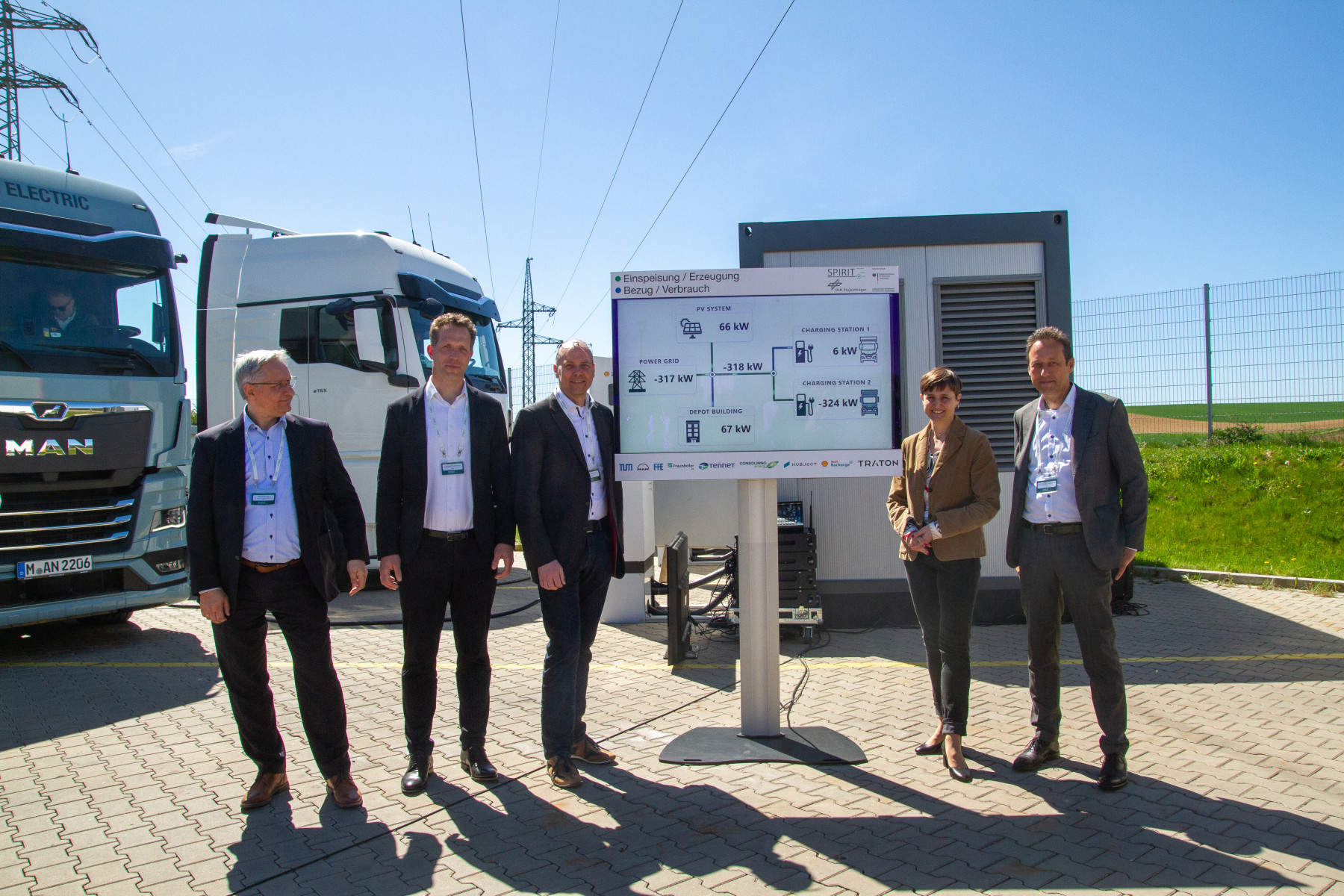
At the Bidi eTruck premiere of project SPIRIT-E in Regensburg (from left to right): Thomas Ille, Head of Early Pilots & Innovation Partnering at MAN Truck & Bus, Conrad Mummert, Lead SBRS Europe, Markus Schmid, Managing Director of Spedition Schmid, Sandra Wimmer, Member of the Executive Board at REWAG, Prof. Dr.-Ing. Markus Lienkamp, Chair of Automotive Engineering, TUM
Three core applications: Vehicle‑to‑Vehicle, Vehicle‑to‑Site and Vehicle‑to‑Grid
Bidirectional charging particularly relevant for electric trucks in regional operations with annual mileage below 100,000 km
Intelligent energy management can reduce energy costs by around 10 to 20 percent
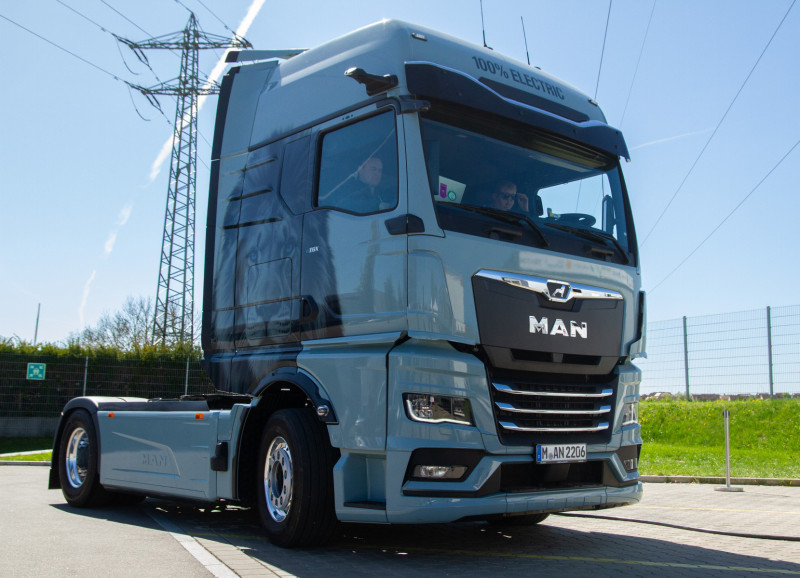
With the research project SPIRIT‑E, MAN Truck & Bus is taking the electrification of freight transport to the next level. For the first time, the commercial vehicle manufacturer publicly demonstrated bidirectional charging under real-world conditions at the premises of logistics company Spedition Schmid in Obertraubling near Regensburg. The demonstration featured a battery-electric MAN eTGX with 480 kWh of usable energy. The technology has the potential to become a key enabler for cross-sector energy solutions by turning electric trucks into flexible energy storage systems. Instead of only consuming electricity, they can store power and feed it back into other systems as needed – improving fleet economics while also supporting the stability of the energy system. Power Bank on Wheels_1Georg Grüneißl, Head of Product Strategy at MAN Truck & Bus, said: “Bidirectional charging is transforming the role of the electric truck. Our eTrucks effectively become power banks on wheels that can help lower energy costs while strengthening the energy system as a whole. SPIRIT‑E has demonstrated the substantial potential of this technology and how electric trucks can actively contribute to the energy transition in the future.”
Three applications are at the forefront of practical use. With Vehicle‑to‑Site (V2S) and Vehicle‑to‑Vehicle (V2V), companies use the energy stored in the truck battery directly at their own facilities – for example to avoid peak loads, increase self-consumption of photovoltaic electricity or support building infrastructure. In practice, this can translate into savings of around 10 to 20 percent on electricity costs. With an annual mileage of 100,000 km, this corresponds to up to 20,000 kilometers driven effectively “free of charge.” Bidirectional charging can therefore make a significant contribution to improving the total cost of ownership of electric trucks compared to diesel vehicles.
Vehicle‑to‑Grid (V2G) further expands this potential. In this case, the eTruck feeds electricity back into the public grid – for instance during periods of high electricity prices or to support grid stability. Fleet operators could generate additional revenue streams in the future. By the end of this decade, V2G is expected to become an increasingly attractive business model as energy markets, grid services and logistics processes become more closely integrated.
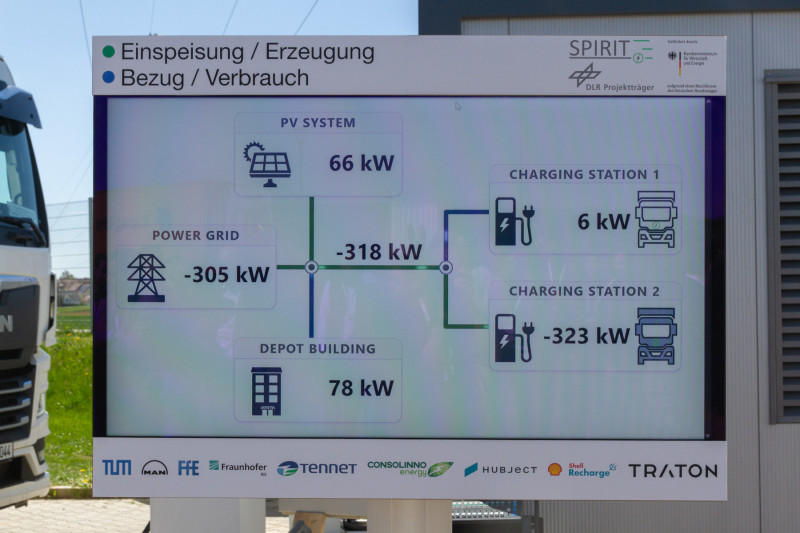
MAN is the first manufacturer in the commercial vehicle sector to functionally demonstrate bidirectional vehicle technology within a research project. As part of SPIRIT‑E, real energy flows have already been implemented, including supplying a building with electricity overnight using eTrucks or charging electric cars from a truck’s battery. However, bidirectional charging is not suitable for all truck applications – for example, where operations do not allow for longer dwell times at a depot. Power Bank on Wheels_2SPIRIT‑E is supported by a broad consortium covering the entire value chain, from vehicle technology and the energy industry to system integration. Partners include the Technical University of Munich (TUM) as consortium lead, Fraunhofer IEE, the Research Centre for Energy Economics (FfE), SBRS (Shell), TenneT, Hubject, Consolinno Energy, and MAN Truck & Bus. Together, they have developed solutions that are being tested in a real-world laboratory at a logistics site.
With SPIRIT‑E, MAN demonstrates how electric trucks can evolve beyond their transport function to become an active part of future energy infrastructure - economically viable, digitally connected, and ready for the next stage of electrification.